
Guardians of the Wild
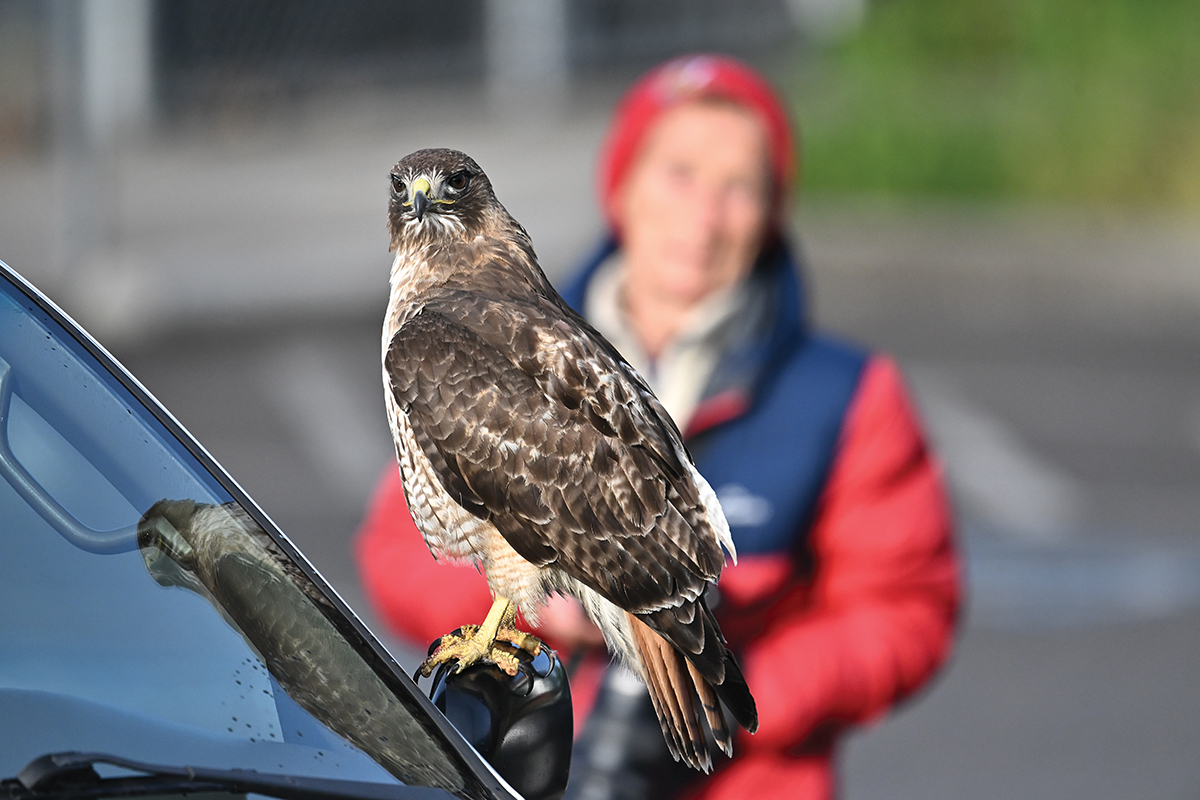
Students gazing out a classroom window isn’t always a bad thing. At McDaniel High School in NE Portland, they’re often following a certain red-tailed hawk —a regular visitor and now local here named Chocolate — soaring above their school and football field.
Besides students, that hawk attracted Melanie (Mel) Loveland and Ginger Neil, often seen locally, cameras aimed skyward.
After meeting in the ‘80s when Ginger began babysitting Mel’s twin grandsons, they discovered a mutual lifelong interest in photography. At seven, Mel was given her grandfather’s huge camera. Ginger got the bug during college.
Finding that they also shared a passion for wildlife, the pair embarked on an enduring adventure. What began with photography eventually grew to include monitoring and advocating for coyotes, ospreys, bald eagles, pelicans, and migrating birds.
They both developed a special love of raptors, which began five years ago when they “met” E/J, a female hawk. “She was the love of my life, an epiphany for me,” Mel says, “starting my journey with red-tailed hawks.” Ginger adds, “They’re known for their impressive eyesight, mating for life, and adaptability. Males live in a two square-mile range.”
Two years ago, they met a juvenile hawk they called Chocolate, “because his coloring reminded us of a chocolate sundae,” says Mel. She and Ginger have tracked him twice daily in his fly zone over McDaniel, which is ideal for hunting.

While a fierce hunter, Chocolate is surprisingly tolerant of humans, even during baseball and soccer games. Many red-tailed hawks don’t live past five because their life is hard, with an average lifespan of 10 to 15 years.
In June, Mel and Ginger found Chocolate seriously injured. “He clung to a light post and didn’t fly for three days,” Mel says. “His chest was sunken, his head hung down, and both eyes were distorted. Something was wrong.”
Chocolate had likely been injured by striking a window at the school. They called a master falconer who brought a special trap with a rat as a lure — which wouldn’t be killed. “It didn’t work,” Ginger says. “Her last resort was flapping the wings of a live quail, and Chocolate descending like an angel.”
The falconer wrestled Chocolate into a calming hood, and Mel and Ginger transported him to Bird Alliance of Oregon.
After a month of intensive rehab, Chocolate was returned to the area. After a week, he flew back to the high school. The community closely followed his story from injury to rehab and long-awaited return through Mel and Ginger’s reporting on social media. Followers grew as news outlets joined in.
“He was stressed,” Mel says of Chocolate’s rehab. “Hawks don’t like human touch. But now he’s back to his routine. And so are we — heading to the school daily at 6:30. Mornings are intense and make us nervous. We usually know where our boy will be — hunting. We don’t leave until we find him. We’re so attached!”
Hawks are federally protected. The group PDX Raptors captures and tags them at airports to keep them from flying into airplane engines. Raptors are also tracked for conservation efforts.
“E/J and a hawk named #21 (now lifelong mates) were banded at SeaTac Airport and, for some reason, flew to Rose City Golf Course,” says Mel.
Another tagged male hawk found E/J there. “He was her first love, and they raised two babies and made history as the first mated tagged hawks,” Mel says. “But he died from rat poison. It was our worst summer. We started a campaign against poisoning rodents. Portland school fields have terrible rodent problems, and rodents attract raptors.”
Chocolate’s injury led them to campaign again, this one for deterrents against window strikes, which increased 40% this year alone. They also work to preserve urban hawk habitats and food sources and prevent loss of tree canopy. “It’s important to plant early seeds in children to notice wildlife,” Mel says.
Hawks are solitary, and it’s rare for them to attack or even get near people. Still, Mel and Ginger urge caution with all wildlife.
“I feel blessed to follow a red-tailed hawk in an urban setting,” Ginger says. “We know we’ve bonded because he doesn’t fly away when we’re in his space. We’re not a threat, and that’s a good feeling. He’s a magnificent raptor.”
Mel adds, “If you’re patient and he sees you for hours daily, magic happens! He recognizes our voices, faces, and movements. You see a hawk’s soul in his eyes. Most male hawks have the look of, ‘I’m going to rip your head off!’ Not Chocolate — he’s so sweet. He doesn’t love us, but we love him.”
Candy Puterbaugh is a wife, mother, grandmother, sister, groan-inducing punster, writer, competitive runner, pet lover, and tender of gardens.