
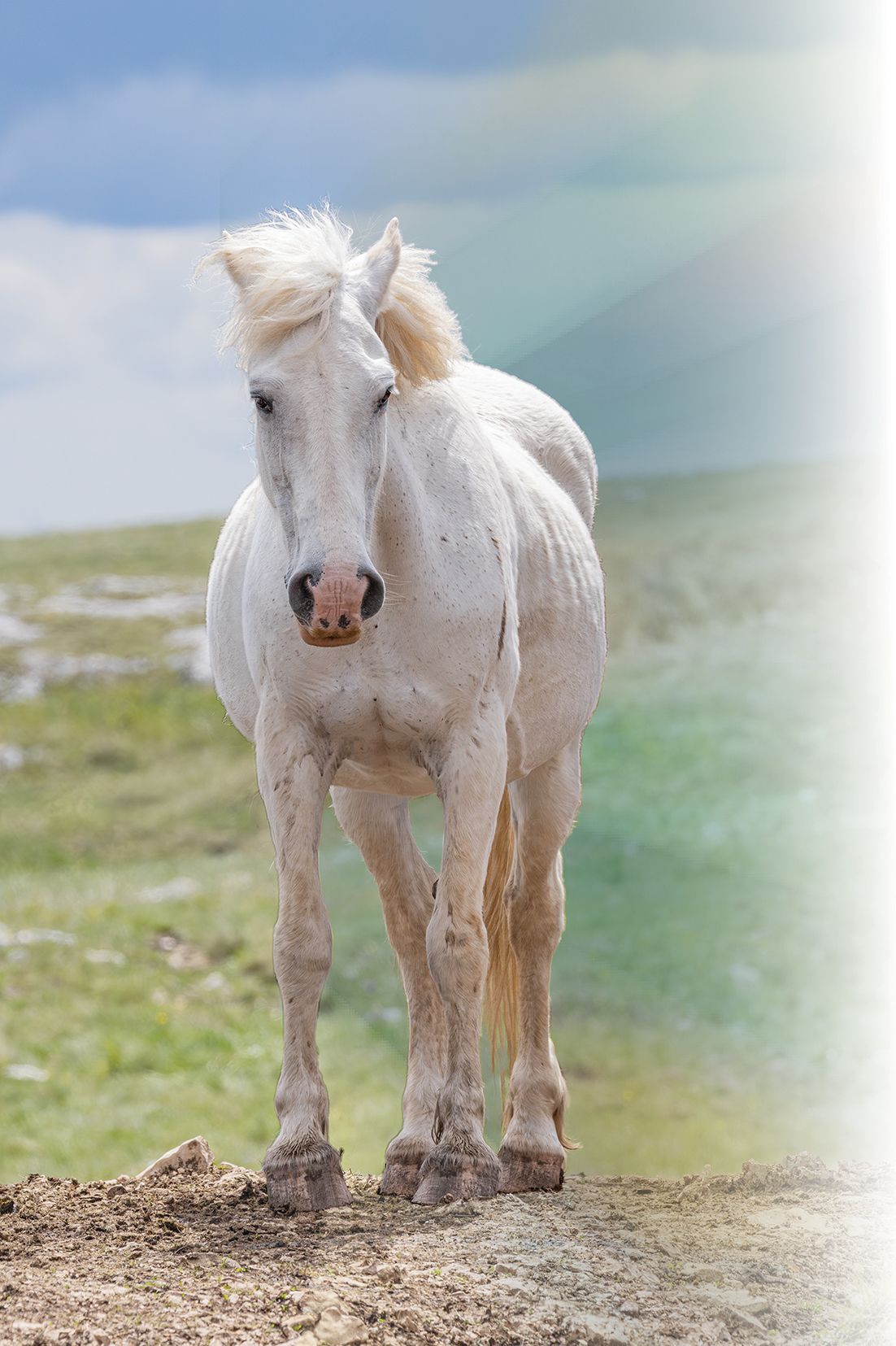
From horse loving child to retiree fighting for their lives
Growing up next door to her grandmother’s farm, Cherise Arthur always loved animals.
On her eighth birthday, her parents gave her a pony of her own.
Riding the filly high on Cooper Mountain, she felt she could see forever. She didn’t yet hear the
wild horses in her future, but today, almost 60 years later, she hears them loud and clear as an advocate for wild horses and burros.
“I’ve always loved horses and was the ‘horse girl’ among four siblings.” she says. “But later I got busy working, with no time for horses. That changed three years ago when I saw a book
with mustangs on the cover. It was“Wild Horse Annie,” about renowned wild horse advocate Velma Johnston.
I read it in three days, retired six months later, and volunteered as an ambassador
for the American Wild Horse Conservation (AWHC). I’m busier now than when I was working!”
Cheri researched Oregon wild horse herds and their plight, and now educates others at libraries and retirement homes. She’s also written a song and three children’s books about horses.
“Many people don’t know the history behind wild horses,” she says, “how they were used by Indians to survive, but weren’t needed later when cars came.”
Wild horses and burros, unbranded and unclaimed, free-roam in family packs across public lands in the western US. Cheri works to help stop their roundups and slaughter because “The Bureau of Land Management (BLM) is trying to eliminate our herds from federal land.”
The BLM’s stated reasons for roundups include overpopulation, protecting vegetation, soil, and water sources; and preventing horse starvation.

Cheri cites different reasons, having to do with the beef industry.
“There are over 5,000 Oregon wild horses in 19 herds plus some burros, and their numbers are in critical decline. In western states, 20,000 horses were sent to Mexico and slaughtered last year. The BLM rounds them up with helicopters — causing stress, injury, and sometimes death. They are chased into corrals to be branded and sold at auction. Some good people want to adopt horses, but others sell them to ‘kill pens’ out of country. If not sold, they’re killed. It’s like flipping cars. And helicopter contractors make millions of dollars.”
Good news came in 1971 with the Wild Free-Roaming Horses and Burros Act unanimously passed by Congress. “That prohibited the capture, injury, or disturbance of free-roaming horses and burros,” Cheri says. “Unfortunately, the act has been amended three times in the BLM’s favor.”
Cheri says the AWHC is making headway by educating the public and working to minimize the wild horse population by darting mares with fertility suppression vaccines. People can help by adopting or sponsoring a mustang, contacting lawmakers with concerns, or donating to sanctuaries that rescue at-risk mustangs.
Helping others is not new for Cheri. She spent five years working in a Lake Oswego elementary school office, then 20 more in public safety, helping troubled high school students.
Several years ago, she self-published Sierra and Star, a book about a girl who’s given a pony for her eighth birthday. She hopes to complete the five-book series and write a young adult book. She teaches self-publishing at Portland Community College, helps four foster children through CASA, and somehow squeezes in an art class.

“I was very close to my grandmother, who co-owned the Crystal Ballroom and was a go-getter!” she says. “I’m a lot like her. This is the Year of the Horse, and I hope to make an impact.
America is the birthplace of the world’s first horses and it’s sad what’s happening to them. At 67, I’m doing things I never thought I’d do — reliving my childhood. You’re never too old to
start over. I’m in my ‘why-not’ stage!
Life’s so short. You have to find your happy.”
Side Note: Recent Developments
Wild horses have long been subjected to terrifying helicopter roundups, removed from their homes on public lands, and transported to government holding facilities. Some ultimately become subject to the Bureau of Land Management’s “sale authority” program, which applies to horses who are 10 years of age or older or who have been offered unsuccessfully for adoption at least three times.
A recent New York Times investigation exposed a devastating failure in that program, finding federally protected wild horses sold by the BLM later entering the slaughter pipeline.
The New York Times investigation — along with reporting and documentation by others working to end these inhumane practices and ensure wild horses can live peaceful, healthy lives — has also raised serious concerns about how the BLM determines sale eligibility. Young, healthy horses have reportedly been offered for adoption for three successive weeks, allowing the agency to count those brief offerings as three unsuccessful adoption attempts and then designate the animals as eligible for sale authority.
Learn more about this issue, including how you can help protect America’s wild horses and burros, at americanwildhorse.org.
Candy Puterbaugh is a wife, mother, grandmother, sister, groan-inducing punster, writer, competitive runner, pet lover, and tender of gardens.