
Trading ‘Exciting’ for Sustainability and Wonder
Candy Puterbaugh
50plus Magazine
Five years ago, a book caused Amy Campion to do an about-face in her garden…and her life. She took a shovel to her exquisite exotic plants, replacing them with native ones. Now she welcomes hundreds of native caterpillars, insects and wildlife to her garden.
It wasn’t Amy’s first about-face. Long ago at the University of Georgia, on the way to becoming a sociology professor, she bought a few house plants. Smitten, she began sneaking over between classes for her Masters in sociology to take classes in horticulture. For the first time, she considered plants as a career. Her roots growing up on a Minnesota farm had caught up with her.
“Though my parents weren’t big gardeners, we had a garden and access to nature,” she says. “I liked exploring the woods, seeing wildflowers, and climbing trees. There I got the desire to be a gardener.”
Her first garden boasted cherry-picked exotic plants from around the world she found exciting. “I used to think native plants were ugly, boring and unimportant,” she says. “I figured birds and bees were getting everything they needed in my exotic garden. I didn’t appreciate native plant evangelists telling me what I should and shouldn’t plant. My garden was for me, for my own pleasure — my sanctuary.”
Then Amy read Doug Tallamy’s Nature’s Best Hope, and it completely changed her philosophy. She admits she hadn’t wanted to read the book but had to as part of a book award committee reviewing it.
“My change of heart shook me,” she says. “It’s painful to change long-held beliefs. Humans are hardwired to stay the course. It didn’t happen overnight.”
It was mostly caterpillars that changed her mind. According to Tallamy, 96% of terrestrial birds in North America feed their chicks insects — primarily caterpillars — and thousands are needed. Two-thirds of caterpillars only eat from one plant family, usually native.
And insects can’t just live in nature and leave our gardens alone because, as Tallamy points out, “Ninety-five percent of the country has been logged, tilled, drained, grazed, paved, or otherwise developed.” There simply isn’t enough pristine nature left out there for wildlife.
“We have to make our developed areas more amenable to wildlife — in particular, to insects — if we want to support the food webs that sustain life on our planet,” Amy says. “After reading Nature’s Best Hope, I looked at my garden, my neighborhood, and the world in general, differently. I saw plants everywhere that were essentially worthless to wildlife, and it broke my heart.”
She tore out plants that didn’t feed anything and replaced them with plants that did. Her favorites are willow, goldenrod, and pearly everlasting — a native perennial that attracts butterflies and “weird insects.”
She added a habitat, including a pocket prairie, tiny dragonfly pond, and old logs for beetles. She left leaves and bare areas for ground-nesting bees, long perennial stems for stem-nesting bees, and long grass for insects.
Today Amy works at Garden Fever, a Portland nursery with an extensive selection of native plants. She and her husband, Jeremiah, a mail carrier, moved here in 2013 after leaving her 16-year job at a Cincinnati nursery.
She shares her native plant knowledge through freelance writing, talks, and as co-author of a book with fellow regional gardening expert, Paul Bonine, called Gardening in the Pacific Northwest: The Complete Homeowner’s Guide. Her photographs grace its pages. A new book on gardening for insects is still a gleam in her eye.
“We need to learn to live with and provide for insects for the food web,” Amy says. “Tallamy’s book made me realize what a dire biodiversity crisis we are in. He focused on what we all can do. I want to try — to focus on what works.”
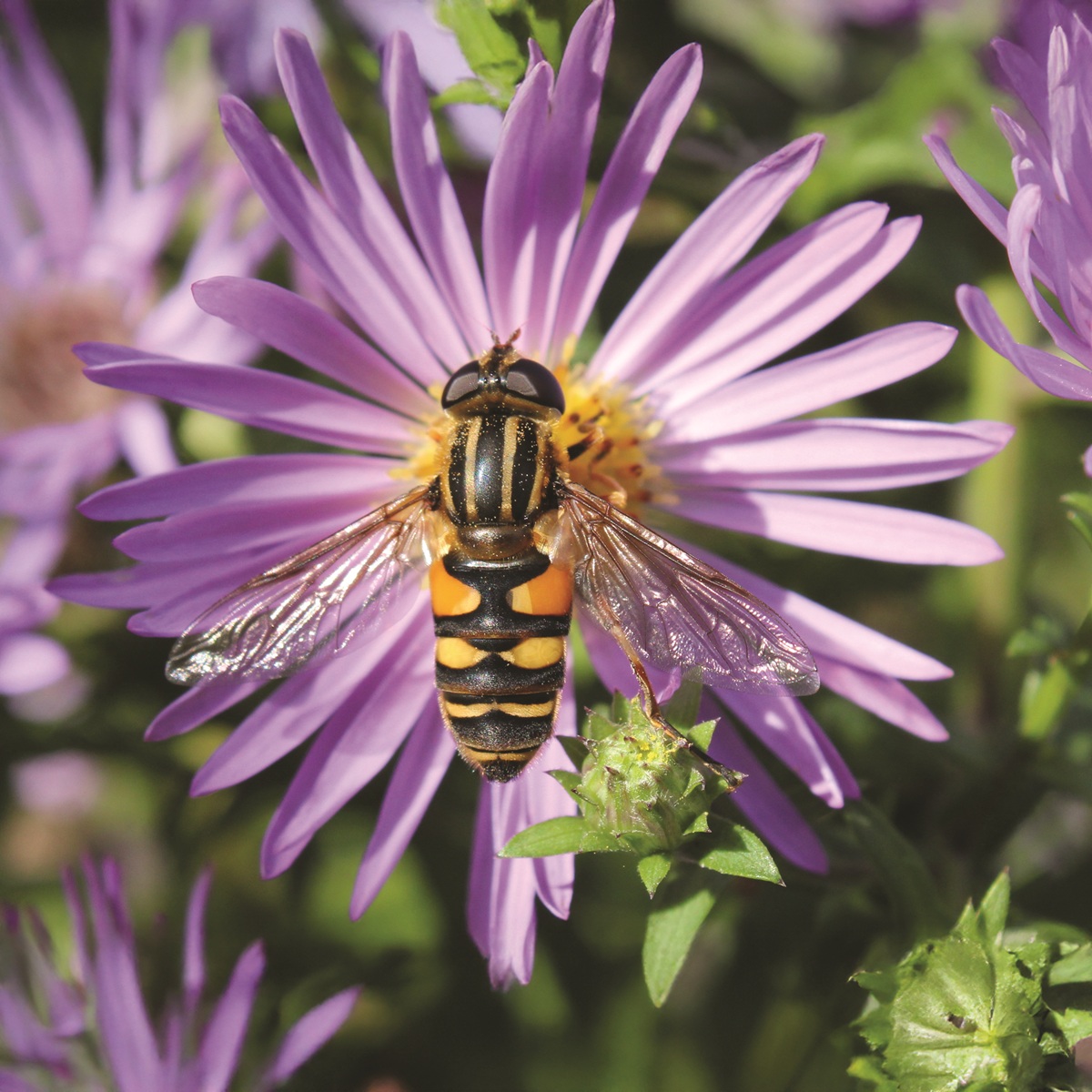
Amy wanders in her backyard daily, camera in hand. “It’s like a safari every day. I never know what I’ll see. I’m obsessed with insects and have been blown away by the diversity of insects I’ve found — about 370 species in my yard! I don’t feel I’m saving the planet but am doing what I can. It feels good to own a little piece of the planet. Many people in the world can’t. It’s an obligation to support that piece of earth. I want to show people what could be out there if you provide habitat. I’m filled with a sense of wonder every single time I step foot in my garden.”
Candy Puterbaugh is a wife, mother, grandmother, sister, groan-inducing punster, writer, competitive runner, pet lover, and tender of gardens.